

Double-entry bookkeeping, without noticing it
Every booking in ClubBalans is a journal entry with debit and credit, as in any real bookkeeping. You do not have to think about it. When you receive membership fees, you book them on Membership fees; when you pay the energy bill, you book it on Energy. ClubBalans makes the counter-entry on the bank, the cash register or the receivables, and refuses a booking that does not balance.
A chart of accounts for clubs
You start with a chart of accounts that suits a club, with categories such as membership fees, sponsorship, donations, canteen revenue, grants, events, hall rent, energy, insurance, federation contributions, materials, canteen purchases and volunteer allowances. You switch off what you do not need, rename categories and create subcategories, for example per team or per event.
Financial years and an opening balance
Your financial year runs from 1 January to 31 December, or over a season, for example from 1 July to 30 June. Financial years follow each other without gaps. In your first financial year you record the opening balance: the balance of the bank and the cash register, the equity and the invoices that are still open at that moment.
A budget next to reality
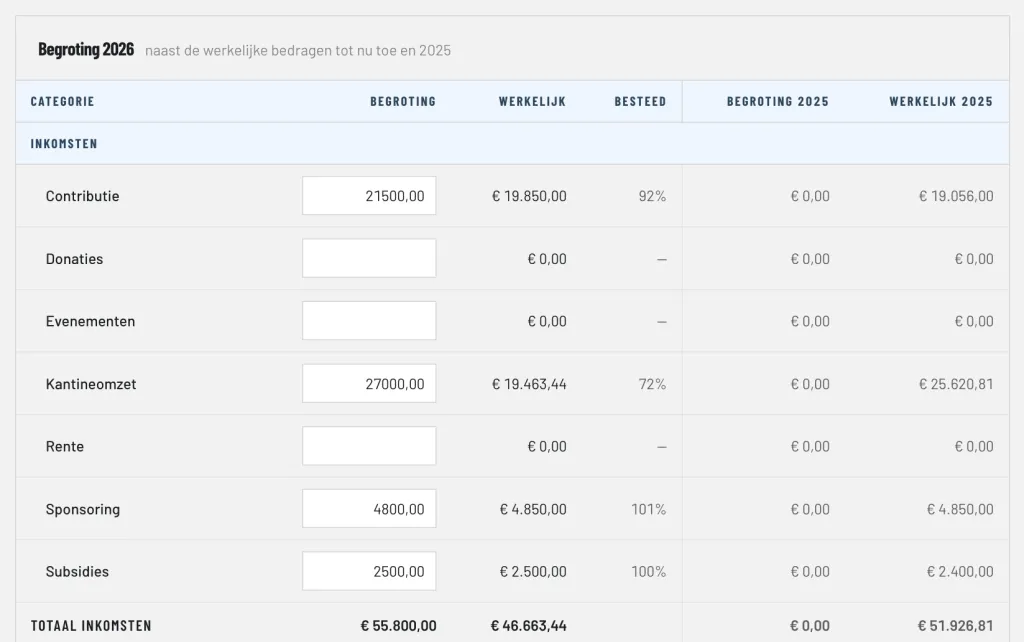
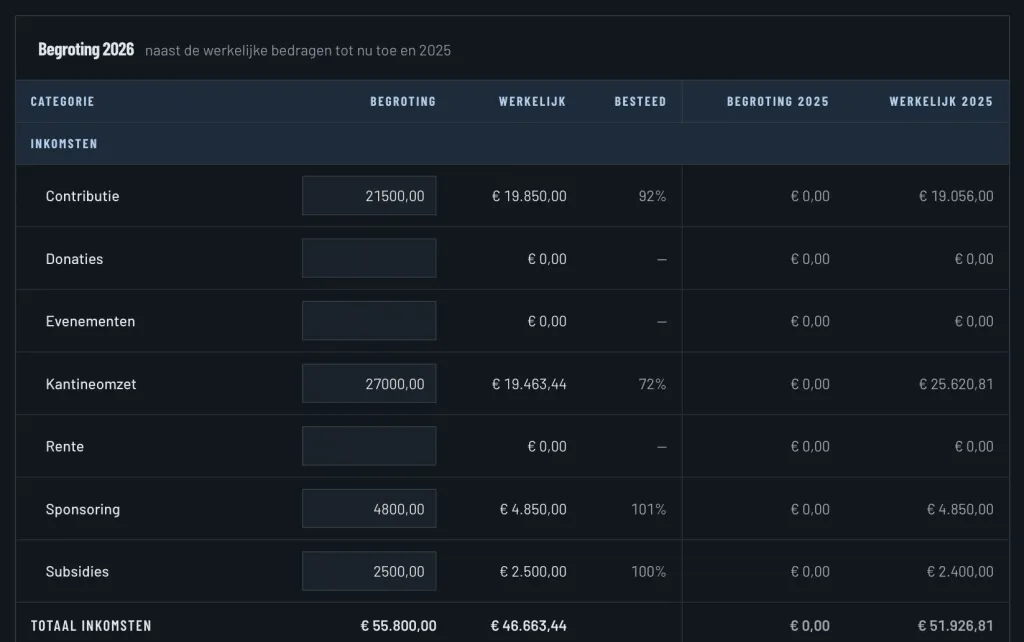
Per category you enter the budget for the financial year. ClubBalans puts the actual amounts next to it, with the percentage already spent or received, and also the budget and the figures of last year. Halfway through the season you already see whether canteen purchases are getting out of hand. The budget also appears in the annual accounts.
Journal entries for the rest
Not everything goes through an invoice, the bank or the cash register. For transfers, corrections or depreciation you create a journal entry on the categories you choose. ClubBalans checks that the entry balances.
Year-end closing
When the bookkeeping is complete and the audit committee has approved the annual accounts, you close the financial year. The result is booked on equity and the year is locked: after that nothing can change. The approved annual accounts always stay correct.
Everything is connected
The bookkeeping does not stand apart from the rest. Membership fee invoices are booked as soon as they are created, and payments you process through the bank or the cash register go straight into the balance sheet. You never enter anything twice.